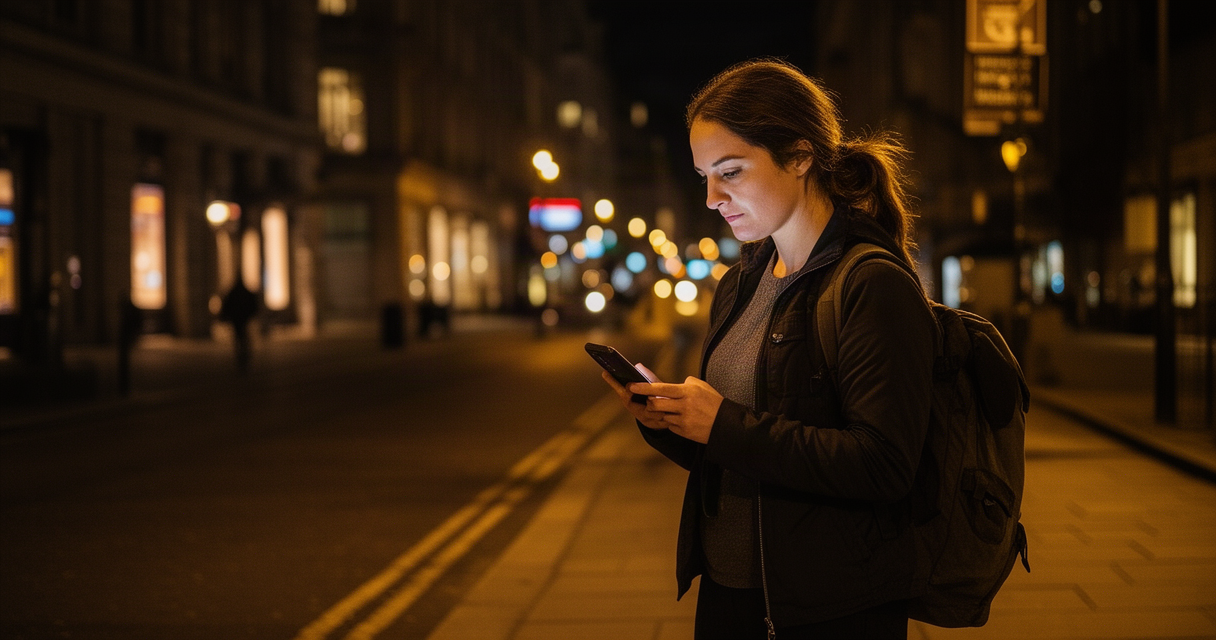
It’s 1am before a solo trip, and every safety-app landing page open in the browser tabs says “AI” somewhere near the top — usually next to a photo of a woman walking alone at night, looking calm because apparently the algorithm has this handled. One of those apps’ headline AI feature isn’t actually live yet. It says so, quietly, in a “coming soon” badge that’s easy to miss when the rest of the copy is doing its best magic-spell impression.
Picking the wrong model here isn’t a minor inconvenience. It’s the difference between trusting a panic button that assumes someone is conscious enough to press it, and trusting a dispatch center that has zero authority to send help once a traveler crosses a border. Get the model wrong and the app becomes a false sense of security — worse than no app at all, because it stops a traveler from doing the boring things that actually work.
The quick answer: these are three different products wearing the same “solo travel safety” label. I’m Alive is a proactive check-in timer. bSafe is a reactive panic button with a voice-triggered SOS. Noonlight is a reactive panic button backed by a real, US-based human dispatch center. None of them work without a phone signal or data connection. None of them replace knowing the local emergency number at the destination.
At a Glance
| App | Model | Who’s alerted | Reach | Real AI? | Price | Best for |
|---|---|---|---|---|---|---|
| I’m Alive | Proactive check-in / timer | The traveler’s own emergency contacts | Global alert-to-contacts | AI voice call is listed “coming soon” — not confirmed live | Free tier; $4.99 one-time; about $29.99/yr; about $39.99/yr (verify on imalive.co) | Solo travelers who might go silent (illness, remote hiking, no-contact stretches) |
| bSafe | Reactive SOS + voice trigger | The traveler’s chosen guardians | Global | No — a voice-command trigger phrase, not AI detection | Conflicting reports, roughly $2–5/mo (verify on getbsafe.com) | Travelers who want fake-call and live-streaming and will test it first |
| Noonlight | Reactive panic button + human dispatch | A professional US dispatch center, then local contacts | Global alert, but dispatch is US-only | None — the value is trained human dispatchers | Free core button; Instant Access about $5/mo; Total Protection about $10/mo (verify on noonlight.com) | US-domestic solo trips, road trips, and as a reactive layer alongside a proactive app |
Two of these three aren’t AI products at all. They’re well-marketed automation and a monitored phone line — which, for something this high-stakes, is exactly what a traveler should want.
I’m Alive: The Daily Check-In (and Why Its “AI” Isn’t Live Yet)
I’m Alive (imalive.co) works on a timer, not a trigger. The traveler sets a check-in window — say, every 12 or 24 hours — and either checks in manually or lets the app read passive phone activity as a signal that they’re fine. Miss the window, and the app starts escalating: reminders first, then increasingly urgent alerts sent straight to the traveler’s own emergency contacts.
That’s the entire mechanism, and it’s the useful part. The feature getting top billing on the marketing page — an AI voice agent that calls the traveler when a check-in is missed, before escalating to contacts — is listed as “coming soon” as of this writing. It is not a confirmed, working feature. Anyone paying for the top-tier plan specifically for that AI call is paying for something that doesn’t exist yet.
The boring part works today, and it’s doing real work for real people. A Google Play review describes using I’m Alive for an autistic adult son who goes days without communicating: “no comms are required; just a button click… I can get some sleep knowing that at least he is alive.” That’s not an AI story. That’s a timer and an escalation list, and it’s doing exactly what it was built to do.
bSafe: The Reactive Panic Button With a Voice Trigger
bSafe (getbsafe.com) is a reactive app — nothing happens until the user makes something happen. Core features include an SOS alarm, live audio and video streaming to a chosen circle of “guardians,” GPS location sharing, a fake incoming call to bail out of an uncomfortable situation, and a Follow Me mode for walking someone through their route in real time.
The marketing leans on “smart” and “voice” language that reads like AI distress detection. It isn’t. bSafe’s voice activation is a trigger phrase the user sets up in advance and says on purpose to fire the SOS — closer to a smart-speaker wake word than to any kind of AI listening for signs of danger.
Reliability is the open question, and it’s worth taking seriously before depending on this one in an actual emergency. An App Store review reports the voice activation “didn’t work after the initial test,” alongside a dead FAQ link and settings that reset every time the app reopens. A Reddit-quoted Google Play review describes discovering that every premium feature was paywalled only “when I finally… press the SOS button” — the worst possible moment to learn a plan doesn’t cover what’s needed. These are individual reports and may be version-dependent, but they’re specific enough to warrant testing the trigger phrase and confirming the plan tier well before departure, not during a crisis. bSafe fits travelers who want the fake-call and live-streaming extras and are willing to run that test first.
Noonlight: The One With Actual Humans on the Other End (in the US)
Noonlight (noonlight.com) skips AI framing entirely and sells something more old-fashioned: a monitored dispatch center staffed by people. Press and hold the Safety Button. Release when safe and enter a 4-digit PIN to cancel. Release without the PIN, and a real dispatcher texts, then calls. No response, and the dispatcher sends police or 911 to the phone’s location.
That’s a “boringly reliable” model in the best sense — no detection algorithm guessing at distress, just a trained person following a fixed protocol. An App Store review describes accidentally triggering it in a museum and getting calls and texts within moments: “it absolutely works when you need it, and FAST… DO NOT FORGET YOUR PIN.” The warning about the PIN is doing real work in that quote — forget it, and a false alarm turns into an unwanted dispatch.
The catch is jurisdiction, and it’s a big enough one that it gets its own section below: Noonlight’s dispatch center operates in the US and requires a US phone number to work at all.
Check-In App vs Panic Button: The Distinction That Actually Matters
This is the split that decides which app is worth having, more than any feature list.
A proactive check-in app like I’m Alive triggers on silence. That’s its entire value: it doesn’t require the traveler to do anything in the moment of danger, because the moment of danger might be exactly when they can’t act — a fall on a remote trail, a medical event, a disappearance. The tradeoff is speed. Escalation depends on the check-in window, so alerts to contacts can arrive hours after something goes wrong, not seconds.
A reactive panic button like bSafe or Noonlight triggers on a deliberate action. That’s near-instant if the traveler can reach the phone and press the button. It’s useless if they’re unconscious, restrained, or the phone is out of reach — the exact scenarios where a check-in timer’s silence-based trigger would still catch something.
Neither model covers the other’s blind spot. That’s the actual argument for stacking, not marketing copy — it’s structural. Travelers and hikers on r/hiking have made a related distinction worth borrowing directly: there’s a real difference between apps that “alert your contacts” and tools that connect to actual rescue dispatch, and conflating the two is how people end up stranded believing help is coming when only a text to a friend went out.
Does Any of This “AI” Actually Do Anything?
Run the three apps through their AI claims specifically, and the picture thins out fast.
I’m Alive has the only genuine AI feature in the group — the voice-agent call on a missed check-in — and it’s still “coming soon” as of this writing. bSafe’s “smart” trigger is a phrase the user sets and says on purpose; useful, but not AI in any meaningful sense. Noonlight makes no AI claim at all. Its entire pitch is that a person, not a model, decides what happens next.
An “AI guardian” still labeled “coming soon” is the safety-app version of a menu item marked “temporarily unavailable” — it’s on the sign, it’s just not on the plate. Which lands on the actual thesis here: what keeps a solo traveler safe is not the AI layer. It’s the boring, reliable automation underneath it — a timer that fires on its own, a human who picks up the phone when a traveler can’t. The AI feature, when it does ship, will be a nice-to-have on top of that. It won’t be the reason to trust the app.
The Caveat That Breaks All Three: No Signal, No Safety App
Every one of these apps needs a working cell or data connection to do anything. Dead wifi, no signal, or a dead battery produces the exact same output from all three: silence. And silence looks identical whether a traveler is fine and just out of range, or genuinely in trouble.
This isn’t a theoretical caveat. Remote hikes, budget-SIM dead zones, and border crossings are precisely the moments coverage is most likely to drop — which is also precisely when a safety net matters most. A traveler heading somewhere with patchy local coverage is better served pairing any of these apps with reliable eSIM data than assuming the app alone has it covered.
No safety app replaces situational awareness — knowing the route, telling someone the plan, carrying a paper backup of key numbers. That holds regardless of which app is installed, because all three fail the same way when the network does.
Noonlight Abroad: What It Actually Does (and Doesn’t) Outside the US
This is the section worth reading twice before trusting Noonlight on an international trip.
Noonlight’s dispatch center is US-based, and the app requires a US phone number to function. Per Noonlight’s own help center, there is no international coverage. Trigger the Safety Button outside the US, and it will not summon local police or ambulance services — the dispatch center has no jurisdiction and no relationship with foreign emergency services. At best, outside the US, a traveler should expect it to notify their own personal contacts rather than any professional responder.
That directly undercuts a claim that shows up in some coverage — that “every woman should have this app before her next trip,” full stop, regardless of destination. For a domestic road trip or a solo hike in the US, that’s a reasonable pitch. For a solo trip to Lisbon or Hanoi, it overstates what the app can do by a wide margin.
The actual fix for international trips is unglamorous: save the destination’s real emergency number somewhere accessible before departure, not after something goes wrong. If a language barrier is likely when making that call, an AI translation app for emergencies abroad is worth having installed ahead of time — it won’t dispatch anyone, but it can be the difference between getting understood and not.
Should You Stack More Than One?
The right combination depends on the trip, not on which app has the flashiest feature page.
A solo woman traveling somewhere new is best served by a proactive check-in app like I’m Alive, paired with the destination’s actual emergency numbers saved offline, and reliable connectivity so the check-in has something to run on. This is the profile where the silence-triggered model matters most — new environment, less local support, higher value in an alert that fires even if she can’t act.
A digital nomad on a longer stay gets more value treating the check-in as a daily habit that piggybacks naturally on logging where they are — pairing well with an itinerary planner already tracking dates and locations. Pairing a safety app with nomad insurance is worth doing for the same kit, but insurance is a financial backstop for the “something already went wrong” scenario, not a substitute for a safety app; it pays for treatment, it doesn’t dispatch anyone.
An occasional US-domestic traveler — a solo road trip, a hike a few states over — is reasonably covered by Noonlight alone. The core Safety Button is free, and human dispatch is the strongest single feature across all three apps, inside the country where it actually has authority to act.
One rule holds across all three profiles: don’t pay for two reactive panic-button apps that do the same job. Paying for both bSafe and Noonlight buys redundant coverage, not better coverage. Pairing a proactive check-in app with one reactive app, on the other hand, actually closes each other’s gaps — and it’s worth noting personal-safety apps are a different category entirely from item-tracking gear; a lost bag is a job for physical trackers for checked gear, not for anything on this list.
No App Replaces Situational Awareness
Worth saying plainly a second time: none of these three apps prevent anything. They help someone find out something has gone wrong, at varying speeds, with varying reach. They don’t stop it from happening.
That’s not a knock on any of them — it’s the honest ceiling of what a phone app can do. If a vendor’s page cites a specific efficacy number (“X% faster response,” “prevents Y assaults”), treat it as vendor marketing until there’s an independent source behind it; none of the three publish anything close to independently verified. The realistic framing is a peace-of-mind layer, not a guarantee — worth having, worth paying for in the right combination, and worth knowing exactly where its coverage stops before relying on it somewhere the coverage doesn’t reach.
Frequently Asked Questions
Does I’m Alive’s AI voice call feature actually work right now?
No. As of this writing, the AI voice agent that’s supposed to call a traveler on a missed check-in is listed as “coming soon” on I’m Alive’s own marketing. The check-in timer and contact-escalation system are live and functional; the AI layer on top of it is not confirmed working.
Is bSafe’s voice activation actually AI?
No. It’s a trigger phrase the user records and says on purpose to fire the SOS alarm — closer to a wake word than to AI distress detection. Some reviews report the voice trigger failing after initial setup, so it’s worth testing before a trip rather than assuming it works.
Does Noonlight work outside the United States?
Not for dispatch. Noonlight requires a US phone number and its dispatch center is US-based with no international coverage, per its own help center. Triggered abroad, it will not send local police or ambulance — travelers should rely on the destination’s actual emergency numbers instead.
What happens to these apps if there’s no cell signal?
All three go silent, and that silence is indistinguishable from a traveler being fine and just out of range. This is a real limitation on remote hikes, in budget-SIM dead zones, and at border crossings — exactly where the risk is highest and coverage is least reliable.
Should a solo traveler pick a check-in app or a panic button?
They solve different problems. A check-in app catches situations where a traveler can’t act — unconscious, injured, out of contact. A panic button is near-instant but only works if the traveler can physically reach and press it. Neither covers the other’s blind spot, which is the real case for using one of each rather than picking a single “best” app.
Is it worth paying for both bSafe and Noonlight?
Generally not. Both are reactive panic buttons alerting a chosen circle or dispatch, so paying for both buys duplicate coverage rather than broader coverage. A stronger combination pairs one reactive app with a proactive check-in app like I’m Alive, which covers a genuinely different failure mode.
The Model Matters More Than the Marketing
None of these three apps is broken, and none of them is magic. I’m Alive’s timer-and-escalation system works today and shouldn’t be confused with its unshipped AI call. bSafe’s voice trigger is a manual shortcut worth testing before trusting it. Noonlight’s human dispatch center is the strongest single piece of technology in this comparison — inside the US, and only inside the US.
The practical move: match the model to the trip, not the app with the loudest AI claim on its homepage. A solo traveler heading somewhere remote or unfamiliar wants the proactive check-in. A domestic road-tripper wants the human dispatcher. Either way, the local emergency number goes in the notes app before the safety app does — because when the signal drops, that’s the only backup left.