Most hotel sites let anyone check a “roll-in shower” box. Nobody verifies it. A property manager ticks it, the listing goes live, and the traveler finds out at 9 p.m. after a 14-hour flight whether the box was telling the truth.
For a power wheelchair user, that gap is not an inconvenience — it is the difference between a shower, a transfer, and a night’s sleep, or none of those, with no backup plan and nowhere else to go. The stakes on an accessible booking are simply higher than on a normal one, and the margin for error is close to zero.
Wheel the World is one of the platforms trying to close that gap. The quick answer: it is a real step up from self-reported OTA checkboxes, because listings are built from physical, on-site measurements rather than a property manager’s guess. But “verified” here means verified against a checklist — not tested against a specific traveler’s specific chair, doorframe, or transfer technique. It is a strong research and booking tool. It is not a substitute for a confirmation call.
Wheel the World vs. AccessNow vs. Wheelmap: How They Differ
Three tools dominate the “find an accessible place” conversation, and they solve different problems. Wheel the World trades coverage for depth. AccessNow and Wheelmap trade depth for scale.
| Wheel the World | AccessNow | Wheelmap | |
|---|---|---|---|
| Data source | Trained on-site mappers, company says (200+ data points per property, per its own site) | Crowdsourced reviews + AI-assisted moderation | OpenStreetMap crowdsourcing |
| Booking | Bookable (hotels, activities, transport) | No booking — info only | No booking — info only |
| Cost to traveler | Free | Free | Free |
| Venue types | Hotels, activities, transport, restaurants | All venue types (restaurants, shops, offices, transit) | All venue types |
| Rating system | Accessibility Verified badge + Accessibility Profile matching | Star rating + written reviews | Green/orange/red traffic-light rating |
| Coverage | Limited to its own catalog — company reports around 800 listings across 117 destinations in 27 countries | City-by-city, quality varies by how active local contributors are | Very broad — the project has published figures north of 1 million mapped locations worldwide |
| Founded | 2018 | 2015, by Maayan Ziv | Community project, OpenStreetMap-based |
AccessNow leans on crowdsourced reviews and AI-assisted moderation across every venue type, not just hotels, which makes it useful for restaurants and shops that Wheel the World never touches. Wheelmap’s traffic-light system is the crudest of the three — green, orange, or red, no measurements behind it — but its OpenStreetMap backbone means it covers places none of the paid platforms ever will.
Wheel the World’s tradeoff is the mirror image: far fewer listings, but each one is (according to the company) mapped by a trained person rather than crowdsourced from whoever happened to visit. Depth versus coverage is the real choice here, not “which app is better.”
What the “Accessibility Verified” Program Actually Checks
Wheel the World’s own marketing states that its “Accessibility Verified” badge is built from more than 200 data points collected by trained on-site mappers, supplemented by traveler feedback after the fact. The claim covers hotels, activities, transportation, and restaurants — a broader net than most accessible-travel directories attempt.
That figure is a company claim, not an independently audited standard. No third-party accessibility body has published a review confirming the 200-point methodology or its weighting. It should be read the way any vendor-reported spec is read: plausible, useful as a filter, not proof.
There’s a second, separate program worth knowing about: Destination Verified. Hotels and destinations pay to be assessed and listed under it — reported at $150 per month, billed annually, according to coverage from Travel Agent Central. That is a meaningful thing to flag honestly: a platform partly funded by the properties it is verifying has a structural incentive to keep those properties on the platform. It does not automatically mean the assessments are wrong. It does mean the traveler is not the only customer in the relationship.
On the investment side, the signals look real rather than cosmetic. Wheel the World has expanded its verified-destination footprint into Oregon and, in 2026, Visit Syracuse in New York, per reporting from TravelPulse. That is ongoing spend on mapping, not a badge slapped on once and forgotten.
Power Wheelchair vs. Manual Chair: Does the Data Distinguish Them?
This is where the assistant-versus-decision-maker distinction matters most. Wheel the World’s Accessibility Profile lets a traveler specify chair type and specific needs, then filters listings against that profile. It is a real mechanism — not a marketing gesture.
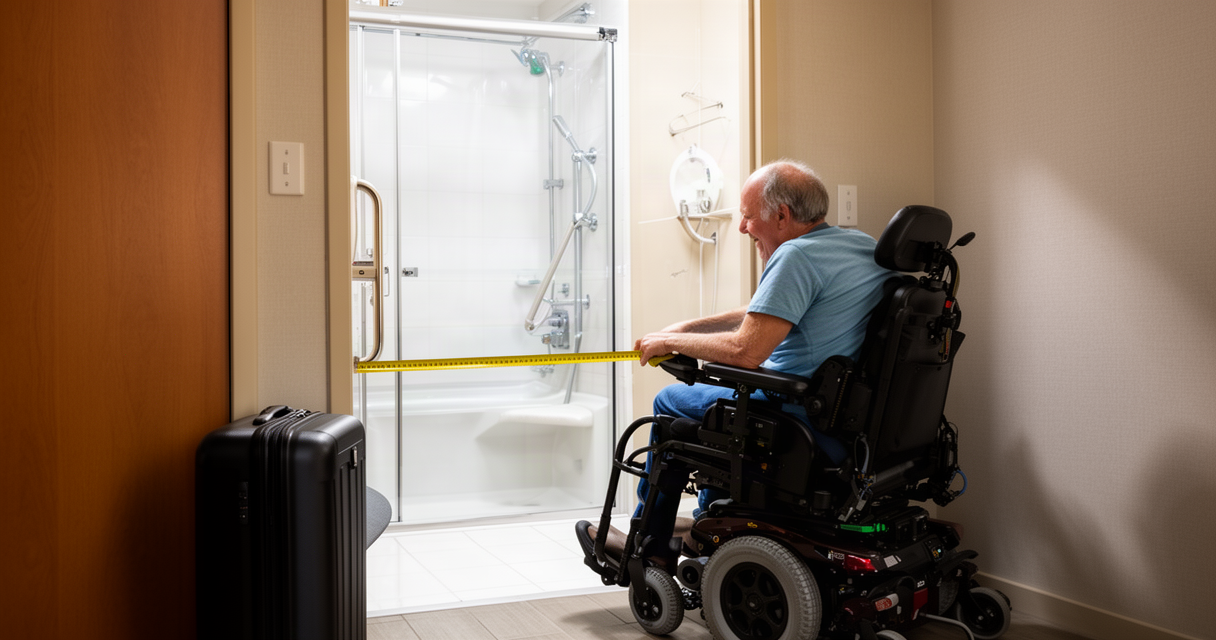
But a mechanism is not a guarantee. Power chairs are heavier, wider, and less maneuverable in tight spaces than most manual chairs. Door width, turning radius, and bed height matter to a power chair user in ways that a general “wheelchair accessible” tag does not capture. A bathroom that works fine for a narrower manual chair can be unusable for a power chair with a larger turning circle.
No independently published methodology confirms that Wheel the World’s underlying scoring weighs those power-chair-specific measurements differently than it weighs manual-chair measurements. The Accessibility Profile is a strong filter for narrowing a search. It is not confirmation that a specific room will work for a specific chair. That gap is exactly where “great assistant, bad final decision-maker” lands hardest — the platform can shrink the list of candidates dramatically; it cannot certify fit the way a tape measure and a phone call can.
What Happens If a “Verified” Property Isn’t Actually Accessible?
Wheel the World states on its own site that it guarantees the accessibility of rooms booked through its platform, and offers a refund if a booked room does not match what was described.
That policy is worth having. It is also worth reading precisely: it is a financial remedy, not a housing remedy. A refund doesn’t produce a shower tonight.
The broader accessible-travel community has documented a consistent pattern with third-party accessible bookings generally — this is general sentiment from r/wheelchairs about accessible hotel booking as a category, not a claim specific to Wheel the World: accessible rooms get reassigned at check-in, and booking through any intermediary leaves the traveler with little leverage to fix it on the spot. As one commenter in that community put it, discussing third-party bookings broadly: “If you booked a room marked as accessible in the room type, you should be good… Do not depend on the comment to be read or noted. Always call the hotel directly and get them to reserve the accessible room you need on your booking.” Another, describing the risk of booking through any intermediary rather than directly with a property: “I would absolutely not book using any third party website that doesn’t specifically cater to disabled travelers… if you use a third party you can’t go after the hotel itself if the requested room (roll in shower) isn’t available.”
The r/wheelchairs community’s broader guidance on any accessible booking — not specific to this platform — converges on the same fix: call the property directly, close to the arrival date, and get the accessible room reconfirmed by name. Wheel the World’s refund guarantee addresses the money. It does not replace that call.
What It Costs to Book Through Wheel the World
There is no separately disclosed traveler-facing booking fee reported for Wheel the World. The company’s revenue appears to come from two places: Destination Verified subscriptions charged to hotels and destinations, and standard built-in commissions on bookings.
The company also runs an affiliate program for travel advisors, paying a reported 3% on accommodations, 5–8% on activities, and 8–10% on multi-day packages, according to figures cited by both Travel Agent Central and TravelPulse. None of that is charged to the traveler directly, but commission structures shape which properties get surfaced and how aggressively.
The practical takeaway: compare the total quoted price against the property’s direct rate before assuming Wheel the World is cheaper or pricier. It’s also worth checking how Booking.com, Hotels.com, and Expedia handle accessibility filters as a baseline — those platforms are free of the verification layer but far cheaper to compare against in raw price terms.
The Verdict: Worth Using, Not Worth Trusting Blindly
Wheel the World is the stronger first stop for high-stakes bookings — international trips, first-time destinations, or any booking with tight tolerances for a power chair. Someone with training physically measured the space before it went live. That is a meaningfully different starting point than a self-reported checkbox on a mainstream OTA.
AccessNow and Wheelmap are worth keeping as free supplements for low-stakes spot checks — a restaurant, a museum, a quick “is this place even worth trying” query — where the cost of being wrong is annoyance rather than a lost night’s sleep. Their crowdsourced breadth covers ground Wheel the World’s smaller catalog never will.
The counter-argument deserves a full airing: a platform funded partly by the $150-a-month subscriptions of the hotels it verifies has a real incentive to keep those hotels listed and looking good. That is a legitimate structural concern, and it does not disqualify the verification data — a trained mapper measuring a doorway is still a trained mapper measuring a doorway, regardless of who pays the invoice. It does mean the badge should be treated as a strong lead, not a closed case.
No single verification — Wheel the World’s, AccessNow’s, or Wheelmap’s — should replace a confirmation call before arrival. The platforms narrow the search. The traveler still closes it. And for activities booked outside the hotel itself, booking accessible tours and activities separately is worth doing through a platform built for that layer rather than assuming a hotel-focused tool covers it.
Frequently Asked Questions
How accurate is Wheel the World’s accessibility data in practice?
There is no independent, published audit confirming accuracy rates. The one Wheel the World-specific data point available from community discussion is limited inventory — travelers in r/wheelchairs have noted that accessible listings on Wheel the World show as already booked during high-demand windows, which speaks to catalog size more than data accuracy.
What if a “verified” property turns out not to be accessible on arrival?
Wheel the World states it will refund a booking if the room doesn’t match what was described. That resolves the financial loss. It does not solve the logistics of needing a room that night, which is why community guidance across accessible bookings generally is to reconfirm directly with the property close to arrival.
Does the platform handle power chairs differently from manual chairs?
The Accessibility Profile feature lets travelers specify chair type and filter listings accordingly. No published methodology shows the underlying scoring weighs power-chair-specific measurements — door width, turning radius, bed height — any differently than manual-chair measurements. Treat the filter as a strong starting point, then verify the specific numbers.
Is booking through Wheel the World more expensive than booking direct?
Not necessarily. There’s no disclosed traveler-facing fee, but revenue from Destination Verified subscriptions and commissions can be baked into rates. Compare the total quote against the property’s direct rate before booking either way.
Is Wheel the World better than free tools like AccessNow or Wheelmap?
For high-stakes hotel bookings, yes — the on-site measurement approach beats crowdsourced reviews for reliability. For quick checks on restaurants, shops, or attractions outside its catalog, AccessNow and Wheelmap’s broader, free coverage fills gaps Wheel the World doesn’t reach.
Book It, Then Confirm It
Wheel the World earns its place as a first stop, not a last word. It replaces the self-reported checkbox with a person who actually measured the room — a real improvement over the mainstream OTA baseline. It does not, and cannot, guarantee that one specific power chair will clear one specific bathroom doorway on one specific night.
The practical path: build out the Accessibility Profile with exact chair type and measurements, book the closest match the platform surfaces, then call the property directly within a week of arrival to reconfirm the room by name. Pairing that with solo travel safety apps worth pairing with accessible trip planning adds a second layer of backup for solo travelers specifically.
A verified badge can narrow the search. It can’t roll into the bathroom for you — that confirmation call is still yours to make.