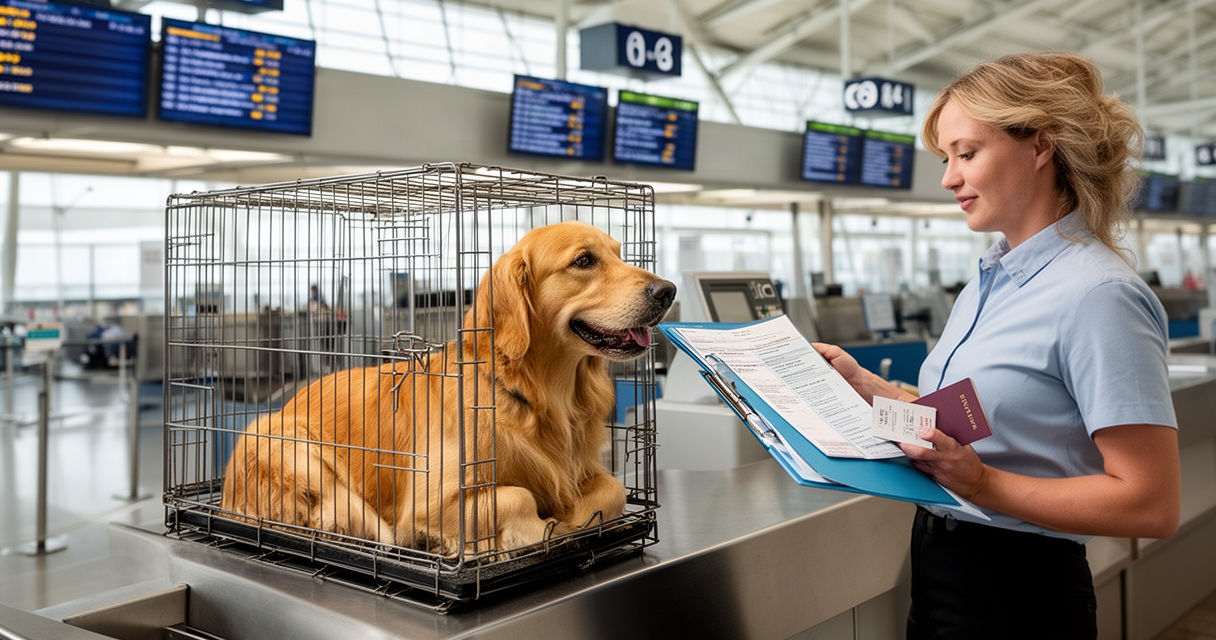
A missing rabies titer. A health certificate signed one day past its validity window. A crate that’s a half-inch too small for the airline’s cargo hold. Any one of these can get a pet pulled off a flight, boarded against the owner’s will, or locked into weeks of quarantine — and it happens to careful, organized owners just as often as careless ones.
The stakes are not abstract. Miss the UK’s 21-day post-vaccination rabies wait or misjudge a country’s health-certificate validity window, and the consequence isn’t a rebooking fee.
The quick answer: none of the three apps compared here — Kruiz, Pet Holiday Club, or Paws Abroad — is a legal authority on pet import rules. The free government sites are. Kruiz is a free AI chatbot for asking travel-policy questions. Pet Holiday Club is an automated document-checklist engine with the broadest claimed country coverage and the least independent verification of the three. Paws Abroad pairs a checklist with an optional human concierge, but only for a limited, shifting list of supported countries.
For a simple route, the free official sources cover it. For a complex or strict destination, a paid app can earn its price by catching sequencing errors. For the hardest cases, an IPATA-registered pet shipper is worth the premium.
What Each App Actually Does (They’re Not Solving the Same Problem)
“AI-powered” is doing a lot of marketing work across all three products, and it means three different things.
Kruiz is a conversational tool. Owners ask it questions — “What does Lufthansa require for an in-cabin dog to Germany?” — and it answers, per its own site, using an AI chatbot called Kruizy. That’s a fundamentally different reliability profile than a rules engine: a chatbot’s answer quality depends on how the question is phrased and what it was trained on, and it doesn’t automatically flag a missed deadline unless asked the right question.
Pet Holiday Club positions itself as an automated document checklist — the traveler enters a route, and the tool generates the paperwork and timeline it claims the destination requires, per its own site. That’s closer to a compliance-tracking product than a Q&A bot, though (as covered below) its accuracy has not been independently verified.
Paws Abroad combines a self-serve checklist and document vault with an optional paid human concierge for owners who want a person double-checking the paperwork, per its own site.
None of these replace the destination country’s own import authority. They’re layers on top of it — and the value of each layer depends entirely on how well it tracks rules that change by country and by season. That’s the same challenge behind AI tools built to track shifting country-by-country compliance rules for other kinds of cross-border paperwork: the rules move, and the tool is only as good as its last update.
Kruiz vs. Pet Holiday Club vs. Paws Abroad vs. DIY vs. IPATA Shipper — Compared
| Tool/Tier | Approach | Coverage | Pricing (verify) | Best For | Biggest Limitation |
|---|---|---|---|---|---|
| Kruiz | Free AI chatbot (Kruizy) for Q&A + document storage | Not disclosed as country-specific coverage; general airline/policy Q&A | Reported free, no disclosed paid tier — verify at kruiz.co | Fast answers to specific policy questions; sanity-checking DIY research | Chatbot guidance, not an automated timeline-compliance check; no independent review data exists |
| Pet Holiday Club | Automated document-checklist engine | Claims 194+ countries (vendor-reported, unverified) | Not confirmed from public sources — check petholidayclub.com | Owners flying to less-common or unusual destinations, if coverage is confirmed | Broadest claimed reach also means the least independently verified accuracy |
| Paws Abroad | Checklist + document vault + optional human concierge | Roughly 14 countries reported at launch (moving target — verify) | Reported tiers range from a low-cost self-serve plan to $2,500+ for full concierge; sources conflict — verify at pawsabroad.co | Owners whose destination is confirmed covered and who want a human backstop | Narrow country list is a hard dealbreaker if the destination isn’t supported |
| DIY (official govt sites) | Free, authoritative source docs (USDA APHIS, GOV.UK, EU) | As broad as the traveler’s willingness to read | Free | Any route, especially common ones (US–EU, US–UK) | Time-consuming, dense, easy to misread a timing window |
| IPATA-registered shipper | Human logistics agent handles the full move | 90+ countries via 485+ member businesses (per IPATA) | Illustrative range $1,000–$6,000+, door-to-door around $4,500, strict destinations $6,000–$8,000+ (industry-reported, not a verified average) | Cargo shipments, legally-mandated agents, complex multi-leg logistics | Expensive; overkill for a simple in-cabin trip |
Kruiz: The Free Chatbot Concierge
Kruiz’s origin story, per its own site and coverage from Yahoo Finance and Morningstar around its launch, traces back to a Heathrow travel disruption that reportedly cost its founders around $3,000 in an unplanned pet-related mess — the kind of lesson that turns into a startup pitch. The app reportedly launched on iOS around April 2025 and Android around the end of May 2025.
Its core strength is speed on narrow questions. Instead of digging through an airline’s PDF policy or a government FAQ, an owner can ask Kruizy directly and get a conversational answer, plus a place to store documents. It’s reported as free with no disclosed paid tier, though that should be verified directly at kruiz.co since terms change.
The limitation is structural, not a flaw in execution: a chatbot answers what it’s asked. It’s not the same as an automated system cross-referencing a specific route against every timing requirement and flagging a mismatch before it becomes a problem. And there is currently no independent app-store rating pattern, Reddit thread, or review site with meaningful discussion of Kruiz’s real-world accuracy — so any verdict on how well it actually performs stays unverified until that evidence exists.
Pet Holiday Club: The Widest Coverage, Least Independent Verification
Pet Holiday Club’s marketing claims are the most sweeping of the three: coverage for 194+ countries, a “2-minute checklist,” language describing its data as “government-sourced” and “vet-verified,” support referencing 35+ airlines, and guidance built around IATA crate specifications. All of this is vendor-reported, per the company’s own site — none of it has been independently confirmed.
Pricing could not be confirmed from public sources at the time of writing. Anyone considering it should check petholidayclub.com directly rather than trust a third-party number.
Pet Holiday Club has also published its own comparisons against Paws Abroad and IPATA shippers on its site — worth noting as non-neutral, since a company comparing itself to competitors on its own marketing page has an obvious incentive. Somewhat notably, those self-published comparisons are close to the only three-way comparison of this space currently online, which is part of why an independent look matters here. No independent review, Reddit discussion, or App Store rating pattern for Pet Holiday Club turned up in research for this article.
Paws Abroad: Checklist Plus Human Help, But Only About 14 Countries
Paws Abroad reportedly launched around May 2025, per Portugal Startup News coverage and the company’s own site, with support for roughly 14 countries at launch. That number is explicitly a moving target — check pawsabroad.co directly before assuming a specific destination is covered, since expanding country lists is a natural next step for a young product and this figure will likely be outdated by the time this article is read.
Pricing is genuinely conflicting across sources. Some describe tiers from roughly $27 up to $2,500+ for full-service concierge; a competitor’s own comparison cites $147 for a self-serve tier and $795 plus $500 add-ons for concierge service. Given the spread, this article won’t assert an exact number — verify current pricing at pawsabroad.co before deciding.
The hybrid model — self-serve checklist plus an optional human reviewing the paperwork — is a genuinely different value proposition than a pure automation play. That mirrors the broader tradeoff behind choosing an AI tool vs. human expert (travel agent) for trip planning: automation is fast and cheap, a human is slower and costs more, but a person catches context an algorithm might miss. The catch with Paws Abroad specifically is coverage. Before paying for concierge service, confirm the destination is actually on the supported list — a coverage gap here isn’t a minor inconvenience, it’s a dealbreaker.
The Free Baseline: Official Government Import Sites
Before paying for any app, the free official sources are worth reading in full, because they’re the actual legal authority.
USDA APHIS publishes country-specific pet-export requirements covering more than 130 countries and is the authoritative source for pets leaving the US. GOV.UK lays out the UK’s rules clearly: the pet must be microchipped before its rabies vaccination, there’s a mandatory 21-day wait after that vaccination before travel, a tapeworm treatment is required 24 to 120 hours before arrival for dogs entering from certain countries, and non-compliant pets face quarantine of up to four months. The EU requires rabies vaccination at 12 weeks or older, its own 21-day wait after vaccination, and a health certificate that’s only valid for 10 days before arrival.
These sources are free, official, and unambiguous about timing — which is exactly where owners get burned. The apps compared here mainly save time and reduce the risk of misreading a dense government page; they don’t replace it as the legal reference. For a common route — say, a healthy dog moving between the US and an EU country with a standard pet passport — most owners may not need to pay for any of the three apps at all. Reading the official page and cross-checking dates is often enough. Pairing that with AI packing list tools that also catch document requirements covers the logistics side without adding a specialized pet-travel subscription.
The Expensive Alternative: IPATA-Registered Pet Shippers
IPATA — the International Pet and Animal Transportation Association — is a trade association, founded in 1979, with more than 485 member businesses across 90-plus countries, per its own about page. It is not a regulator and does not itself move pets; its members do, as licensed pet-shipping agents who handle everything from paperwork to cargo logistics.
Cost is the tradeoff. Industry sources such as pet-shipper sites ffexpresspets.com and transconpet.com describe an illustrative range of $1,000 to $6,000-plus, with door-to-door service running around $4,500 and strict destinations (heavy quarantine countries, complex customs) pushing into the $6,000–$8,000-plus range. These figures are industry-reported estimates from shippers themselves, not an independently verified average.
An IPATA agent makes sense for unaccompanied cargo shipments, destinations that legally require a licensed agent, or trips with genuinely complex logistics — multiple flight legs, unusual crate requirements, or strict quarantine protocols. Most owners flying a healthy pet in-cabin on a standard route should not default to this tier; it’s the insurance policy for the hardest cases, not the standard-issue solution.
The Decision Framework: Which Tier Do You Actually Need
For a simple, common route — a healthy pet, a standard pet passport corridor like US–EU, in-cabin travel — the free government sites plus a Kruiz chatbot sanity check on any specific airline question is a reasonable, low-cost path.
For a complex or strict destination — the UK, Australia, Japan, the UAE, or anywhere with quarantine rules and titer-testing timing — a paid tool earns its keep if it actually catches sequencing errors a human might miss reading a dense government page. That means Pet Holiday Club, if the destination is confirmed within its claimed 194+ country coverage, or Paws Abroad, if the destination is confirmed on its roughly 14-country supported list.
For the hardest cases — cargo shipments, legally mandated agents, multi-leg trips with unusual logistics — an IPATA shipper functions as insurance against a mistake that costs far more than the shipper’s fee.
The core position here: use whichever AI tool fits the route to eliminate paperwork errors, not to replace double-checking against the vet and the official import authority. An app is a second pair of eyes, not a substitute for the traveler’s own verification.
Where Even the Best App Can’t Save You
This is where the honest limits matter most, and it’s also where owners on Reddit describe the worst outcomes.
Timing windows are where people get burned — the 21-day post-vaccination wait, health certificate validity, rabies-titer lab turnaround, and USDA processing queues that can back up unpredictably. An owner on r/AmericanExpatsUK described a case involving a rabies-vaccination lapse that led to quarantine on arrival in the UK, despite the pet owner — reportedly a veterinary technician with eight years of records — believing the paperwork was in order; the border authority’s interpretation of the timing was final. A traveler on r/TravelWithPets described a veterinary clinic backing out of signing off on paperwork just four days before a flight to France, resulting in over $2,600 in costs and pets left behind. Another account on r/TravelWithPets described a single-letter typo on an already government-endorsed health certificate discovered two days before departure.
No app, however well-built, overrides a customs officer’s discretion, a last-minute change in airline policy, or an aircraft swap that changes the cargo hold’s temperature or size specifications. These are the failure modes an algorithm structurally cannot fully prevent.
This is not official guidance. Always confirm requirements directly with a veterinarian and with the destination country’s official import authority — requirements and timing windows change, sometimes with little notice.
Our Take: What We’d Actually Do
For a first-time or simple move, start with the free official government sites and use Kruiz’s free chatbot as a sanity check on specific questions. There’s no reason to pay for anything yet.
For a complex or strict destination, paying for Pet Holiday Club or Paws Abroad only makes sense after confirming the destination is actually covered — then re-verifying every date and requirement against the official government page independently, rather than trusting the app’s output blindly. Pet Holiday Club’s broader claimed coverage makes it the safer default for unusual destinations, but it’s also the least independently verified of the two. Paws Abroad’s narrower country list is a real constraint, but its optional human concierge is a more honest hedge against an algorithm’s blind spots.
For the hardest routes — cargo, mandated agents, complex multi-leg logistics — get a quote from an IPATA-registered shipper and treat the cost as insurance. This is the same worth-it math that applies elsewhere in travel: the same logic applies to travel insurance decisions, and it echoes AirHelp’s worth-it verdict on flight compensation tools — pay for the tool when the downside of going without it is expensive enough to justify the fee, not by default.
Frequently Asked Questions
Is Kruiz free to use for pet travel document checking?
Kruiz is reported as free with no disclosed paid tier, per its own site. That should be verified directly at kruiz.co, since app pricing and feature tiers can change without much notice.
How much does Pet Holiday Club cost?
Pricing could not be confirmed from public sources at the time of writing. Check petholidayclub.com directly for current pricing before signing up.
Does Paws Abroad cover my destination country?
Possibly — but its supported country list is roughly 14 countries as of its launch and is a moving target. Confirm the destination is on the current supported list at pawsabroad.co before paying for any tier, especially the concierge service.
Can an AI pet travel app replace checking with USDA APHIS or GOV.UK directly?
No. All three apps here are convenience or error-catching layers, not the legal authority. USDA APHIS, GOV.UK, and the EU’s official pet-travel pages remain the authoritative sources, and none of the apps compared claim otherwise in their own terms.
What’s the biggest pet travel document mistake owners make?
Based on community accounts, it’s usually a timing miscalculation — missing the 21-day post-rabies-vaccination wait, letting a health certificate’s validity window lapse before arrival, or assuming a vet appointment for signoff will happen on schedule when clinics can and do cancel close to departure.
When is an IPATA-registered pet shipper worth the cost?
For cargo shipments, destinations that legally require a licensed agent, or trips with genuinely complex multi-leg logistics. For a simple in-cabin trip on a standard route, it’s typically overkill given the $1,000–$6,000-plus illustrative cost range reported by shippers.
The Bottom Line
Kruiz, Pet Holiday Club, and Paws Abroad are convenience and error-catching layers, not the legal authority on pet import requirements. Which tier is worth paying for depends entirely on how complex and unforgiving the specific route is — a simple US–EU pet passport trip needs almost none of this; a strict quarantine destination or a cargo shipment might need all of it.
The practical next step is to check the free official government site for the destination first. That alone reveals how complex the route actually is, which makes it much easier to judge whether an app’s convenience — or a shipper’s expertise — is worth paying for. Whatever path gets chosen, confirm final timing directly with a veterinarian and the destination country’s official import authority before booking anything irreversible.
The paperwork won’t kill the trip — assuming any app has already handled it for you is what will.
References
- USDA APHIS — Pet Travel requirements: https://www.aphis.usda.gov/aphis/pet-travel
- GOV.UK — Bring your pet animal to Great Britain: https://www.gov.uk/bring-pet-animal-to-great-britain
- European Commission — EU pet travel rules: https://food.ec.europa.eu/animals/movement-pets/eu-legislation/pet-travel-within-eu_en
- IPATA — About IPATA: https://ipata.org/about-ipata/
- Kruiz — official site: https://kruiz.co
- Yahoo Finance / Morningstar — Kruiz launch coverage (referenced via kruiz.co press materials)
- Pet Holiday Club — official site (vendor-reported claims): https://petholidayclub.com
- Paws Abroad — official site (vendor-reported claims): https://pawsabroad.co
- Portugal Startup News — Paws Abroad launch coverage
- FF Express Pets — pet shipping cost estimates (illustrative, industry-reported): https://ffexpresspets.com
- TransCon Pet — pet shipping cost estimates (illustrative, industry-reported): https://transconpet.com
- r/AmericanExpatsUK — community thread on rabies-vaccination timing and UK quarantine (platform anecdote, no individual identified)
- r/TravelWithPets — community threads on vet clinic signoff delays and health-certificate errors (platform anecdotes, no individual identified)
Not official guidance. Requirements, pricing, and coverage change — always verify with a veterinarian and the destination country’s official import authority before traveling with a pet.