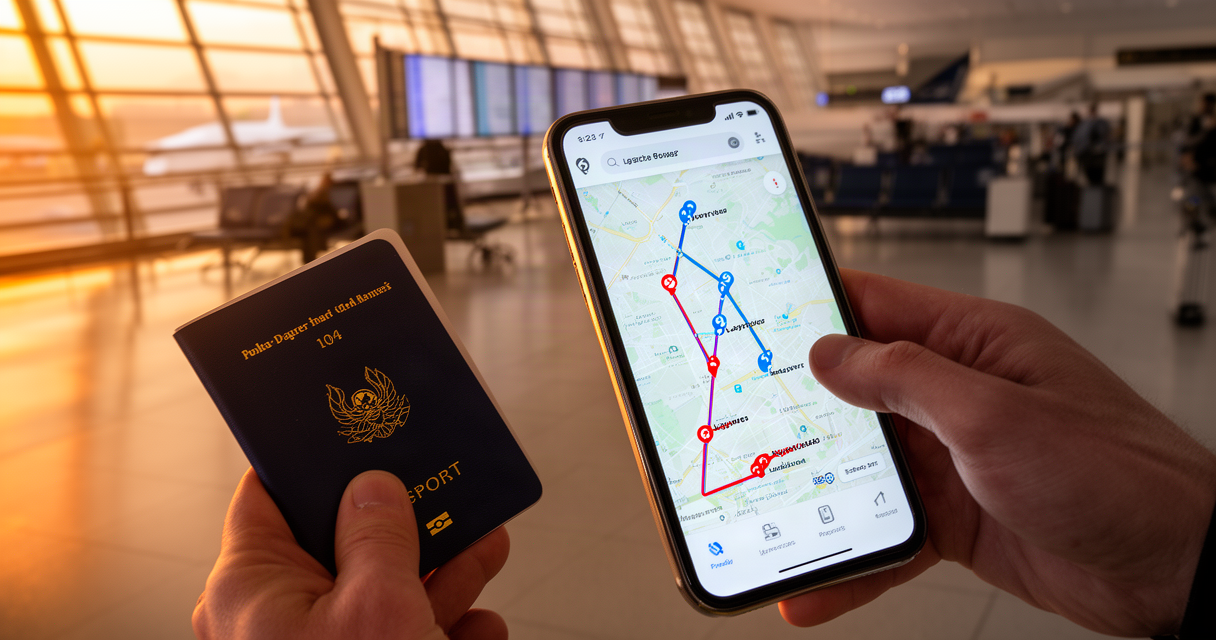
Picture a five-country itinerary — a flight through Doha, a few days in Dar es Salaam, then Nairobi before heading home. Which of those stops needs a visa, which just needs an electronic authorization, and which one wants proof of a yellow fever shot isn’t always obvious. The instinct is to download one of the big three apps — Sherpa, iVisa, or Atlys — hoping it’ll sort it out. The question is whether it actually will.
The stakes here aren’t abstract. Getting a transit requirement wrong doesn’t mean filling out a form late — it means getting turned away at check-in, or being denied boarding entirely because an airline’s system flagged something the app didn’t. That’s a canceled trip, not a paperwork headache.
The short answer: none of the three big visa-requirement apps — Sherpa, iVisa, or Atlys — is built to catch every transit-visa or multi-country edge case, and none of them should be your only source of truth. Sherpa is the strongest free option for checking each leg of a complex itinerary. iVisa is the best fit if you want someone else to file the paperwork for a fee. Atlys is newest, fastest-growing, and still proving out its AI claims. All three sit downstream of the actual authorities — your government, your destination’s government, and your airline’s Timatic system — and that hierarchy matters more than which app has the nicer interface.
Here’s the full breakdown, including where each one has actually failed travelers.
Not the Same Kind of Tool
Lump these three together and you’ll misuse all of them. They solve different problems.
Sherpa is a requirement checker. Enter your passport, your route, your dates — it tells you what documents you need for each leg and links you to where to get them. It doesn’t file anything on your behalf.
iVisa is a paid filing service. It checks requirements too, but its business is completing and submitting visa and eVisa applications for a fee on top of the government cost. Think of it as a concierge, not a lookup tool.
Atlys sits in between — a mix of requirement checking and guided filing, with an AI layer it’s actively building out following a funding round in early 2026.
None of the three is a substitute for a full trip-planning workflow. If you’re stacking multiple countries and time zones into one itinerary, the requirement check is one piece of a bigger puzzle that also includes flights, lodging, and day-by-day logistics — which is where the debate between AI itinerary planners vs. a human travel agent actually becomes relevant for anyone doing serious multi-country planning.
Why Travel Documentation Got More Confusing in 2026
Two new entry-authorization systems have been reshaping European and UK travel, and neither has landed cleanly.
The UK ETA is real and mandatory now. As of February 25, 2026, travelers from roughly 85 visa-exempt nationalities — including the US, Canada, Australia, Japan, and most EU/EEA countries — need an Electronic Travel Authorisation before flying to the UK. British and Irish citizens, and anyone who already holds a UK visa or settled status, are exempt. It is not a visa; it’s a pre-screening authorization, similar in spirit to the US ESTA. The fee has moved twice already — £10 when it launched in October 2023, £16 from April 2025, and £20 from April 2026 — which tells you the pricing isn’t settled either. Confirm the current fee and your eligibility directly at gov.uk before you assume last year’s number still applies.
The EU’s ETIAS is a different story, and this is where a lot of travel content online is simply wrong. The cost is set: €20, valid for three years or until your passport expires, whichever comes first. What is not confirmed, as of this writing in August 2026, is when it actually launches. The EU pulled its own Q4 2026 target in July 2026, and the working assumption in the travel industry now is a 2027 rollout. Anything you read claiming a firm 2026 date should be treated as outdated. Check travel-europe.europa.eu directly before you build a booking around it.
None of these three apps — Sherpa, iVisa, Atlys — control either system’s timeline or pricing. They’re reflecting government data, and when that data is in flux, so is what the app tells you. Once ETIAS is live, it will also be worth remembering that it confirms entry eligibility, not how many days you’ve spent in the Schengen zone — a separate problem that tools like AI Schengen day-counting and tax residency trackers are built to solve, and that ETIAS approval does nothing to fix.
Sherpa vs iVisa vs Atlys: The 3-Way Comparison
| Tool | What It Actually Does | Free or Paid | Covers Transit Visas Proactively? | Monitors Changes? | Best For |
|---|---|---|---|---|---|
| Sherpa | Requirement lookup by passport + route + dates, links to official application sources | Free | Partial — flags transit legs only if entered explicitly as a stop | Yes, claims continuous monitoring (Sherpa’s own stated figure) | Multi-leg trips where you want a free second opinion per country |
| iVisa | Requirement lookup + paid application filing service | Free to check, paid to file (plus service fee) | No — destination-focused lookup, transit rules easy to miss unless searched separately | Limited — relies on periodic database updates, not real-time claims | Travelers who want the paperwork handled and are willing to pay for it |
| Atlys | Requirement lookup, guided filing, and an emerging AI eligibility layer | Free to check, paid for guided filing/concierge add-ons | No — passport-based flagging, not itinerary-aware for transit stops | Growing — expanding via its 2026 funding round, not yet a mature feature | Travelers who want a modern app experience and are comfortable being an early adopter |
No app here gets a clean “yes” on transit visas. That’s the single most important row in this table, and it’s the reason the rest of this article exists.
Sherpa: The Free Standard, With a Real Asterisk
Sherpa’s pitch is straightforward: put in your passport and itinerary, get a requirement checklist, click through to official sources. It’s free, and for a single-leg trip it’s genuinely useful — fast, clean, no upsell pressure.
The company claims it monitors more than 2,000 sources and tracks roughly 55 policy changes an hour. That’s Sherpa’s own stated figure, not an independently audited number, and there’s no public third-party verification of it. Treat it as a marketing claim about scale, not a guarantee that any specific requirement update reaches the app instantly.
Reported Trustpilot ratings put Sherpa around 4.7 out of 5, based on roughly 7,000 to 9,000-plus reviews depending on which locale page you’re looking at. That’s a solid number, but Trustpilot scores vary by region — the aggregate headline figure isn’t a single global count.
Where Sherpa earns its reputation is multi-leg checking: run each stop of your itinerary through it separately, and you get a fuller picture than checking your final destination alone. Where it falls short is exactly the same place: it only checks what you tell it to check. If you don’t manually enter your Doha layover as a leg, Sherpa has no way of flagging that Qatar has its own entry rules for that stop.
iVisa: The Paid Filing Route, With a Domain-Confusion Trap
iVisa’s core business isn’t checking requirements — it’s filing on your behalf. You pay a service fee on top of whatever the government charges, and iVisa handles form completion and submission. For travelers who find visa paperwork genuinely stressful or confusing, that’s a real value proposition.
iVisa advertises a 99% approval rate. That figure is iVisa’s own marketing claim; there’s no independent audit backing it, and “approval rate” for a filing service is inherently going to look high if the service itself pre-screens obviously ineligible applications before submitting them. Read the number as a sales claim, not a peer-reviewed statistic.
The Trustpilot situation for iVisa is more complicated than a single star rating suggests. The main ivisa.com domain reports somewhere in the 4.0 to 4.4 out of 5 range across roughly 60,000 reviews — a reasonably strong track record at volume. But there’s a genuine domain-confusion problem: several lookalike “iVisa”-branded domains carry Trustpilot ratings as low as 2.1 to 2.7, rated “Poor.” Before you enter payment information anywhere, confirm you’re on the actual ivisa.com and not a copycat site that scraped the brand name. This is a documented pattern in the visa-services space generally, and it’s the single easiest mistake to make when you’re rushing to book last minute.
Atlys: The Newest Money, The Least-Proven AI
Atlys closed a $36 million Series C in March 2026, led by Susquehanna Asia Venture Capital, with MakeMyTrip joining the round. The company says it’s processed roughly 450,000 visas to date, and part of the new funding is earmarked for an AI roadmap aimed at eligibility checking and application automation.
That AI eligibility-check capability is worth being precise about: it’s a stated roadmap item tied to the funding announcement, not a mature, independently verified feature already running at scale. Announcing intent to build AI tooling and having AI tooling that reliably catches every eligibility edge case are two very different claims, and the gap between them is where a lot of visa-app frustration lives.
That frustration shows up in community reports. A traveler in r/visas described entering a passport number incorrectly into Atlys, having the app accept the entry without flagging the mismatch, and later being denied boarding because the submitted document didn’t match the passport presented at the airport — an expensive lesson in what happens when you hand data entry to a third party. Separately, a Google Play reviewer complained that Atlys’s chatbot support was effectively useless for a rejected application, with no clear path to reach a human agent when something went wrong.
Neither of those reports proves Atlys is worse than its competitors — every visa app has a subset of unhappy users. But they’re consistent with the honest read on Atlys right now: newer product, faster growth, and a support and verification layer that hasn’t caught up to the marketing yet.
The Multi-Country and Transit-Visa Failure Mode
This is the part that matters most if your trip touches more than one border.
Airlines don’t check your entry eligibility against Sherpa, iVisa, or Atlys. They check it against IATA’s Timatic database — the actual authoritative system gate agents use to decide whether to let you board. Timatic and these consumer apps are built from different data pipelines, updated on different schedules, by different organizations. When a country changes a rule, Timatic and a given app can be out of sync for days or weeks, and there’s no guarantee which one updates first. A traveler in r/visas caught one competing checker still stating a UK entry rule that had been wrong since January 2025 — a reminder that “the app said so” is not a defense at the gate.
A concrete pattern: countries requiring proof of yellow fever vaccination for travelers transiting through a yellow-fever-endemic country often get missed by apps that check your final destination but don’t separately flag the layover country’s transit rule. A commenter in r/tanzania recounted exactly this risk — being warned to carry a yellow fever certificate because airlines sometimes demand it before boarding based on your nationality, and describing being held more than 24 hours over a transit of only a few hours. The written rule and how it’s enforced on the day are not the same thing.
Onward-ticket requirements compound the problem because enforcement is genuinely inconsistent. Plenty of countries technically require proof of an onward or return ticket to enter, but whether that gets checked depends on the airline, the specific airport, and sometimes the individual agent working the counter that day. In a widely discussed r/digitalnomad thread about a Thailand entry issue, other travelers noted that immigration officers rarely check for onward tickets there, but the airline might — meaning the same document rule gets enforced or ignored depending on which counter you’re standing at. An app reporting “not required” isn’t necessarily wrong about the written rule; it may just be reflecting how rarely it’s enforced, which is a different thing from the rule not existing.
The takeaway: for any itinerary with more than one country or a layover in a country you’re not otherwise visiting, check each leg individually, and don’t assume a clean result on your final destination covers your transit stops.
What These Apps Don’t Do
Beyond the transit gap, there are three things all three tools consistently miss because they’re simply outside their scope.
Travel insurance requirements. A growing number of countries require proof of travel insurance at entry, and none of these three apps verify or track your insurance status — they may mention it exists as a requirement, but they don’t confirm you’re covered. That’s a separate research step, and it’s worth doing before you fly, not at the immigration desk. A proper nomad travel insurance comparison is a better use of ten minutes than assuming a visa app has this handled.
Schengen day-counting. Once ETIAS eventually launches, and even under the current rules, none of these tools track your rolling 90-out-of-180-day allowance across the Schengen area. That’s a cumulative math problem, not an entry-eligibility check, and getting it wrong risks an overstay flag on a future trip.
Onward-ticket documentation. As covered above, several countries want to see proof you’re not planning to overstay, and that’s a booking-management task, not a requirements-lookup task. Anyone juggling a multi-stop route benefits from a dedicated system for tracking which legs are booked, which are provisional, and what documentation each one needs — the kind of job trip-organizing apps for multi-stop itineraries are actually designed to handle, rather than a visa checker bolted onto that use case.
Paid Intermediary vs. Applying Direct: The Honest Math
Here’s where the paid-filing model gets uncomfortable if you run the numbers.
Take the UK ETA as the clearest example. The official government fee is £20 as of April 2026, applied directly at gov.uk. iVisa’s service fee for processing the same authorization has been reported by Google Play reviewers at roughly four times the government cost — meaning a traveler pays for both the £20 government charge and a markup on top of it, for a form that, on the official site, takes most travelers under ten minutes to complete themselves. One reviewer described the app surfacing when they searched for the official service, creating urgency about processing time, and charging for expedited handling on something the government site turns around quickly on its own.
That markup isn’t necessarily a scam — you’re paying for someone to review your submission and, in theory, catch errors before they become a boarding denial. Whether that’s worth 4x the base cost depends entirely on how confident you are filling out a straightforward government form on your own. For anything as simple as an ETA or ESTA, applying direct is very likely the better financial call. For genuinely complex visa categories — work visas, long-stay permits, anything with supporting-document requirements you’re unfamiliar with — a paid filing service starts to earn its fee.
These Are Planning Aids, Not Authorities
None of Sherpa, iVisa, or Atlys is a government body, and none of them is the final word on whether you can enter a country or board a flight. Entry and visa requirements change frequently, and confirming them is ultimately the traveler’s responsibility — not the app’s.
Before booking or flying, especially on any multi-country, transit-heavy, or weak-passport itinerary, confirm requirements directly with the official government or embassy site for every country involved, and separately confirm with your airline. If an app and an airline disagree at the gate, the airline’s Timatic-driven system and the judgment of the border officer win. The app does not get a vote at that point, no matter how confident its interface looked.
This isn’t a knock on any of these tools specifically — it’s a structural fact about how consumer travel apps relate to government systems. The same caution applies broadly across AI travel tools; some genuinely save time and reduce errors, and others just add a confident-sounding layer over information you needed to verify anyway. Knowing which is which — see other AI travel tools worth trusting (and which aren’t) — is as important as picking the right visa checker in the first place.
Which One Should You Actually Use
Simple, single-country trip. Skip all three. Check the destination government’s official immigration or foreign-affairs site directly — it’s free, authoritative, and takes about the same amount of time as using an app.
Complex, multi-stop itinerary. Run Sherpa on every single leg individually, including layovers you’re not planning to leave the airport for. It’s free, and the marginal cost of checking one more country is zero.
Weak-passport or transit-heavy routing. Don’t rely on any single app. Cross-check whatever a requirement checker tells you against your airline directly and the destination government’s site, particularly for any country you’re transiting rather than visiting outright.
Want it handled, willing to pay. iVisa’s guided filing is the more mature option for straightforward applications; Atlys’s concierge add-ons are worth considering if you’re comfortable being an earlier adopter of a still-developing product. Either way, read the fee breakdown before you submit, and confirm you’re on the legitimate domain.
The Bottom Line
Treat Sherpa, iVisa, and Atlys as what they are: helpful first-pass checks, not final answers. Sherpa is the strongest free tool for individually checking each stop on a complicated route. iVisa is worth its markup only when the alternative is genuinely confusing paperwork you’d otherwise botch yourself. Atlys is a company to watch, not yet one to fully trust with an AI-driven eligibility call.
None of them replaces the two sources that actually decide whether you get on the plane: the destination government and your airline. Check those first. Use the apps as a sanity check, not a boarding pass.
Frequently Asked Questions
Is ETIAS launching in 2026?
Not confirmed. The EU removed its own Q4 2026 target in July 2026, and 2027 is now the more likely window in industry discussion. Confirm current status directly at travel-europe.europa.eu before planning any trip around it.
Do I need the UK ETA if I’m only transiting through a UK airport?
It depends on whether you leave the secure transit zone, and the rules have changed more than once since the ETA became mandatory on February 25, 2026. Check your specific transit scenario at gov.uk rather than assuming a layover is automatically exempt.
Can Sherpa, iVisa, or Atlys replace applying for a visa directly with a government?
No. Sherpa is a lookup tool that points you to official sources; iVisa and Atlys file paperwork on your behalf for a fee, but the underlying approval still comes from the government, not the app. None of them issues or guarantees a visa themselves.
Is iVisa’s 99% approval rate accurate?
It’s iVisa’s own reported figure, not an independently audited statistic. Approval rates for filing services can look high partly because the service screens out obviously ineligible applicants before submission. Treat it as a marketing claim, not a verified benchmark.
What should I do if an app says one thing and my airline’s system says another?
Trust the airline. Airlines check eligibility against IATA’s Timatic database, which is the system border agents and gate staff actually rely on. A consumer app disagreeing with Timatic doesn’t change what happens at the check-in counter.
Are these apps worth using for a simple one-country vacation?
Usually not necessary. For a single, straightforward destination, checking the official government or embassy site directly takes about the same time as using an app and removes a layer of interpretation between you and the actual requirement.
References
- UK ETA guidance and fee history — gov.uk, https://www.gov.uk/guidance/apply-for-an-electronic-travel-authorisation-eta
- ETIAS official information and revised timeline — travel-europe.europa.eu, https://travel-europe.europa.eu/etias_en
- Atlys $36M Series C funding coverage — Entrackr, https://entrackr.com/news/visa-processing-startup-atlys-raises-36-mn-in-series-c-funding-11218314
- Atlys $36M Series C funding coverage — The Tech Portal, https://thetechportal.com/2026/03/17/atlys-secures-36mn-in-series-c-funding-led-by-susquehanna-asia-vc/
- Sherpa product and monitoring claims — joinsherpa.com, https://www.joinsherpa.com/products/travel-requirements
- iVisa product, pricing, and approval-rate claims — ivisa.com, https://www.ivisa.com/
- Sherpa Trustpilot reviews — Trustpilot, https://www.trustpilot.com/review/joinsherpa.com
- iVisa Trustpilot reviews (main domain and flagged lookalike domains) — Trustpilot, https://www.trustpilot.com/review/ivisa.com
- r/visas — thread on an Atlys passport-entry mismatch and subsequent boarding denial, and a stale-rule catch on a competing checker
- r/tanzania — thread on a yellow fever transit-vaccination requirement and inconsistent airline enforcement
- r/digitalnomad — thread on a Thailand onward-ticket entry issue and inconsistent airline-vs-immigration enforcement
- Google Play Store — iVisa and Atlys app reviews (markup complaints and AI chatbot support limitations)
Entry and visa requirements — and regulatory timelines like ETIAS — change frequently and are accurate only as of publication (August 2026). Always confirm current requirements with the official government/embassy site and your airline before booking or flying.